
Many organisations are stuck with AI. Despite, running pilots, experiments and prototypes, very few projects reach day-to-day use or deliver clear business value.
Industry analysts see the same pattern repeatedly:
- Gartner expects at least 30% of generative-AI projects to be abandoned after proof of concept by the end of 2025, often because of poor data, unclear value and weak risk controls.
- MIT’s “GenAI Divide” research reports that around 95% of enterprise generative-AI initiatives show no measurable business impact, with only a small minority breaking out of failed pilots.
When we mapped this onto a simple AI Adoption–Value Matrix, most organisations sit in the bottom-left: low adoption and low realised business value.
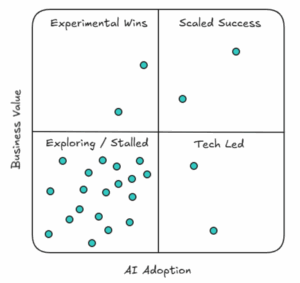
Common pitfalls in AI adoption
The reasons for stalled AI projects are usually straightforward:
- use cases are vague or too broad
- user adoption is an afterthought
- delivery is improvised rather than repeatable
- nobody is quite sure who owns change management
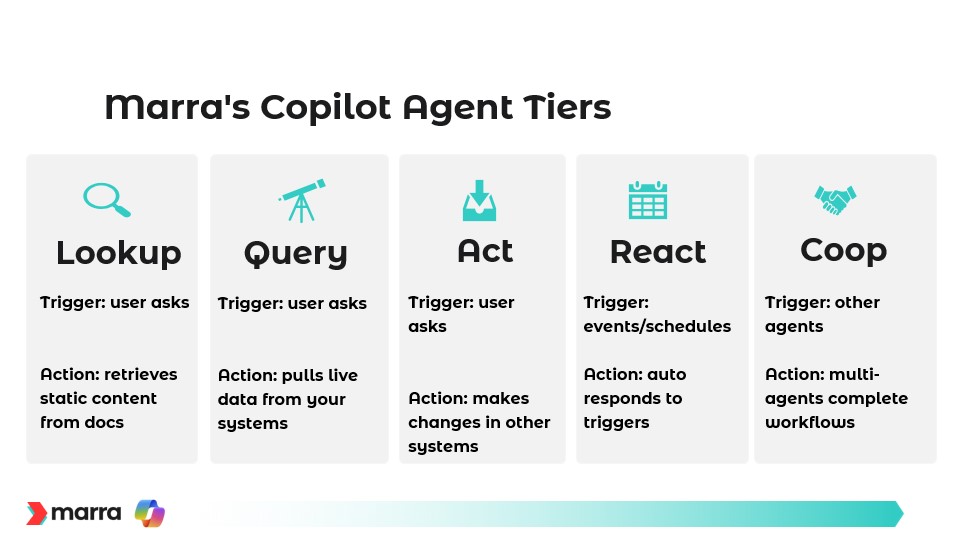
The real work is building delivery muscle and practising the adoption and change-management steps that make AI land in day-to-day use. Enter Marra’s tiered Agent model approach:
- Five levels of capability: Lookup, Query, Act, React and Coop.
- Gives teams a clear landscape and shows how different types of agents fit into it.
- For a first step, Tier 1 (Lookup) is the most effective entry point.
What is Tier 1 (Lookup)?
Tier 1 is deliberately simple.
It retrieves accurate answers from existing knowledge sources and appears inside the tools people already use, such as Microsoft Teams. Because the technical footprint is low, the organisation can focus on the harder parts:
- choosing a specific, useful use case
- running proper UAT with real users
- documenting behaviour and hand-offs
- setting ownership and governance
- preparing people for how their work will change
Through this, teams build confidence and delivery discipline. Even at this level, a Tier 1 agent can reduce repetitive queries, surface gaps in content, and provide immediate value.
Case study: The Mercian Trust
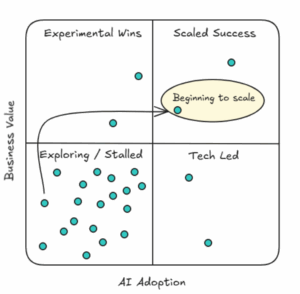
The Mercian Trust’s experience shows what this looks like in practice. They began deep in the bottom-left of the AI Adoption–Value Matrix: overwhelmed HR, Finance and Governance teams, inconsistent channels, and no AI in use.
Marra delivered a solution that was roughly 80% Tier 1 Lookup, with about 20% Tier 3 Escalation (routing and notifications). The impact was clear: over 9,000 actions in the first weeks, more than 70% of routine queries resolved automatically, and user satisfaction at 4.5 out of 5.
As shown in the below diagram, this moved them one step up and one step right on the AI Adoption–Value Matrix. They have strengthened their delivery capability and have increased the organisation’s confidence in how to choose use cases, run UAT and manage change. A Tier 1 agent gave them a safe, repeatable way to build momentum, laying the foundation for further progress.
Scaling up beyond Tier 1
Once Tier 1 is working, extending into Query, Act, React or Coop becomes much easier. The organisation already understands how to choose use cases, run UAT, manage risk and support change, so the extra technical capability can land on solid ground.
If you want to identify a high-value, low-risk starting point or your AI journey, begin with a Tier 1 agent. It’s a practical, proven way to build momentum and lay the groundwork for more advanced capabilities.
If you want to move your organisation out of the bottom-left in the AI Adoption-Value Matrix then let’s talk!