
Most organisations are well past experimenting with AI.
Teams have tried the tools. Many are already using copilots, automation, and AI-powered workflows. The real question now is not whether AI can add value.
It is whether organisations are set up to realise that value.
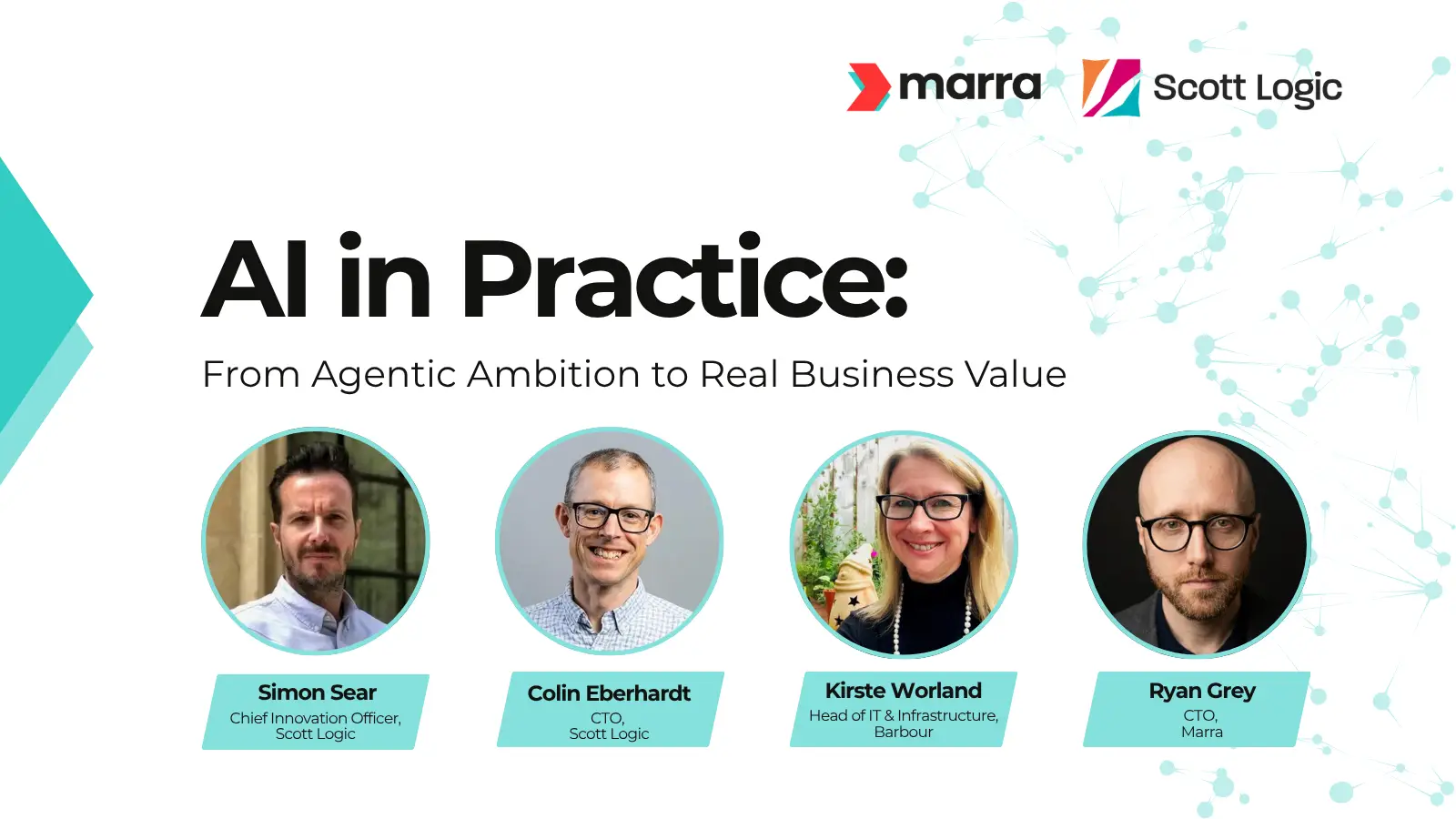
This was the focus of our recent AI in Practice event with Scott Logic. Technology and business leaders, along with AI practitioners, shared what it actually takes to move from ambition to real business outcomes.
Insights from Simon Sear, Chief Innovation Officer at Scott Logic; Colin Eberhardt, CTO at Scott Logic; Kirste Worland, Head of IT and Infrastructure at Barbour; and Ryan Grey, CTO at Marra, highlighted themes that apply wherever you are on your AI journey. We’ve shared some of the key takeaways below, or you can watch the full recording here.
The biggest challenge isn’t technology
When AI adoption slows down, it is easy to blame the tools.
In reality, the biggest barrier is often people and culture.
Simon put it simply: people and culture are the biggest challenge. Not because people do not want to innovate, but because most businesses are built for efficiency and predictability. AI needs something else. It needs space for experimentation, learning, and sometimes getting things wrong.
The panel echoed this point throughout the discussion.
Ryan pointed out that while technology teams often have time to explore new tools, teams in HR, Finance, Operations, and Legal are already stretched. Without time to learn and experiment, AI adoption will always struggle.
The lesson is clear. AI adoption is not just a technology project. It is a people project.
AI should create space, not replace people
One of the most practical examples came from Kirste and the work being undertaken at Barbour.
Their goal is not to replace creativity with AI. It is to give creative people more space to do their best work. By automating repetitive tasks, teams spend less time on admin and more time on what matters.
This is an important distinction. The most successful organisations are not asking:
“How can AI replace this person?”
They’re asking:
“How can AI remove the work that gets in the way of this person’s impact?”
This shift in mindset leads to better adoption, stronger engagement, and outcomes that matter.
Stop focusing on tools and start focusing on ways of working
One of the strongest points Colin raised was that organisations often place too much emphasis on choosing the right tool. Whether it’s Cursor, Claude, Copilot or another platform is rarely the deciding factor. The organisations seeing the greatest gains are changing how they work.
In software development, AI is making code cheaper and faster to produce. This changes how teams deliver software and challenges old ways of working. The opportunity is not about adding a new tool but about redesigning processes to align with what AI can and cannot do.
This applies beyond software. Every business function needs to rethink how work gets done to unlock real value.
As Simon highlighted, simply automating existing processes may deliver incremental efficiency gains. Transformational results require organisations to reimagine how work gets done in the first place.
Measurement matters more than experimentation
Many organisations have spent the last two years running pilots and proofs of concept. The challenge now is moving past experimentation.
Throughout the event, a recurring theme emerged: successful organisations are measuring outcomes, not activity. Teams need to understand what success looks like before they start implementing AI and establish meaningful ways to track progress.
Ryan shared that organisations should take baseline measurements before introducing AI, using existing KPIs where possible. This helps teams see if productivity, quality, or customer outcomes are actually improving.
Without measurement, AI projects risk becoming just interesting experiments. With measurement, they can drive real business change.
Governance and enablement must go hand in hand
Many still see governance as something that slows innovation. The organisations making progress take a different approach.
The keynote examples showed the need for secure platforms, clear guardrails, and safe access to AI. But governance alone is not enough.
Education, upskilling, and enablement matter just as much. The organisations seeing success support AI adoption with:
- Clear governance and guardrails
- Enterprise AI platforms
- Ongoing education and training
- AI champions or ambassadors
- Strong leadership sponsorship
- Continuous experimentation and iteration
Most importantly, these organisations know that training is not a one-off. As AI evolves, people need to keep building skills and confidence.
What this means for SMEs
Many of the examples shared during the event came from large enterprises, but the lessons are equally relevant for SMEs.
In fact, smaller organisations are often in a stronger position to move quickly.
The organisations making progress are not always the ones with the biggest budgets.
They’re the organisations that:
- Understand where AI can create value.
- Create time for people to learn.
- Measure success from the outset.
- Put the right governance in place.
- Focus on adoption, not just implementation.
Technology on its own will not create real change. People, process, and culture will.
How Marra helps organisations put AI into practice
At Marra, this idea is at the heart of our approach to AI Enablement.
We often see organisations overwhelmed by the pace of change or stuck in isolated pilots and proofs of concept.
Our focus is on helping organisations build the foundations for sustainable AI adoption. That means governance, platform setup, skills development, business process improvement, and finding practical use cases that deliver real value.
Because successful AI adoption is rarely about the technology alone. It is about helping people use that technology confidently, safely, and effectively. That is where real business value starts.
Watch the full recording
This summary only scratches the surface. The full conversation includes candid reflections, real examples, and practical advice from leaders navigating transformation in some of the UK’s most complex organisations.
Watch the full recording to hear the panel’s insights first hand.
If you want help shaping your own AI or digital strategy, our team at Marra is always happy to talk.